
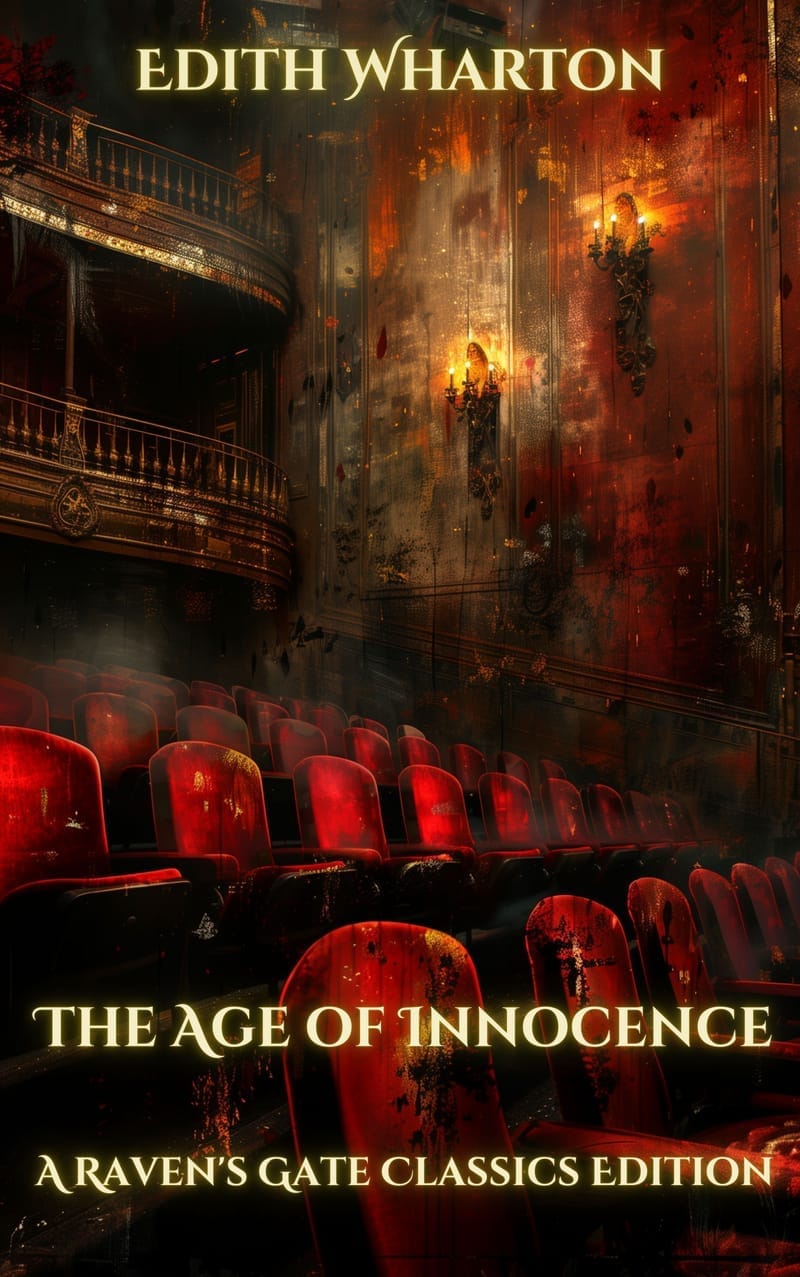
The Age of Innocence (Annotated): A Raven's Gate Classics Edition
by Raven's Gate Classics · Classic Horror Reimagined
Newland Archer is engaged to the perfect woman. May Welland is beautiful, well-bred, and untroubling. Their marriage will be the event of the season. Old New York approves. Then May's cousin walks into the opera box, and Archer's carefully arranged life begins to crack.
Countess Ellen Olenska has left her husband in Europe and returned to New York seeking refuge. She is everything Archer's world distrusts: independent, unconventional, foreign in manner if not in blood. She is also the first person who has ever made Archer feel genuinely alive. What follows is not a melodrama of passion and ruin but something far more unsettling: a story about a man who sees his cage clearly and cannot make himself leave it.
Edith Wharton published the novel in 1920, looking back at the 1870s society of her parents from the wreckage of the First World War. She wrote an autopsy of a civilization, and the corpse is gorgeous. Every dinner party is a political act. Every bouquet carries intelligence. Every silence lands harder than speech. The Pulitzer committee gave it their prize in 1921, the first time the award went to a woman. The novel earned it by being pitiless and beautiful in equal measure.
This Raven's Gate Classics edition includes the complete, unaltered text of the 1920 first edition across all thirty-four chapters. A biography of Edith Wharton covers the full arc of her life: the stifling childhood in Old New York society, the disastrous marriage to Teddy Wharton, the intellectual awakening and the affair with Morton Fullerton, the move to France, the extraordinary war relief work and the Legion of Honour, the late creative flowering, and the death at seventy-five in Saint-Brice-sous-Foret.
Commentary covers the architecture of social entrapment and how Wharton builds the cage before the reader sees it, the triangle of Archer, May and Ellen and why none of them is hero or villain, the anthropology of manners and Wharton's ethnographic method, the devastating final chapter and why Archer stays on the bench, and the prose style as an instrument of irony operating at the level of the sentence. Curated further reading includes the Lewis and Hermione Lee biographies, Cynthia Griffin Wolff's critical study, and Wharton's essential companion novels.
No summaries. No study questions. No academic gatekeeping. Just the novel that dissected American manners with surgical precision, and the context to understand the woman who escaped the world she anatomized.
More by Raven's Gate Classics

Carmilla
Little Women (Annotated): A Raven's Gate Classics Edition

The Jungle Book (Annotated): A Raven's Gate Classics Edition
The Scarlet Letter (Annotated): A Raven's Gate Classics Edition

The Second Jungle Book (Annotated): A Raven's Gate Classics Edition
Crime and Punishment (Annotated): A Raven's Gate Classics Edition